| Home | Portfolio | Education | Info | Miranda Fine Arts | Links | Contact |
Youth and Family Education
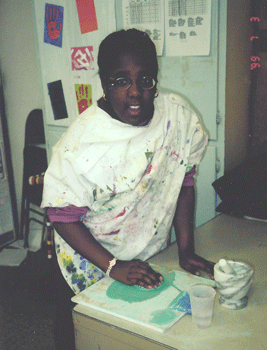
 Patricia Miranda has been working in
schools, universities, and libraries for over a decade, introducing
students and adults to the unique experience of creating their own art
supplies-making paint from stones, insects, flowers, earth, and other
natural materials; "illuminating" their art with real 22k gold leaf;
writing on animal skin parchment with turkey quill pens; and creating
their own handmade books. Stemming from her expertise in medieval and
Renaissance manuscript illumination, her program is often included alongside
the medieval history curriculum. Patricia Miranda has been working in
schools, universities, and libraries for over a decade, introducing
students and adults to the unique experience of creating their own art
supplies-making paint from stones, insects, flowers, earth, and other
natural materials; "illuminating" their art with real 22k gold leaf;
writing on animal skin parchment with turkey quill pens; and creating
their own handmade books. Stemming from her expertise in medieval and
Renaissance manuscript illumination, her program is often included alongside
the medieval history curriculum. With a focus on European traditions, Miranda has extended the concept of her programs to encompass many disciplines and cultures. Connections are made to Eastern, Asian, African and Indigenous traditions, which often utilized similar and related techniques in their own unique art forms. The program expands to focus on science, the environment, history, literature, art; even math through the recipes for paint and ink. All foster a connection between the student and the larger world, especially to the natural world, and to the subjects taught in school. This work offers a truly interdisciplinary and hands-on method that is not only educational but also interactive and fun! The ideal of learning is to offer a new way for students
to draw connections between everything in the world around them,
from art supplies to material objects to food, to the earth from
which everything comes, and to draw their own visions and conclusions
from this knowledge. Many people have never seen a vegetable in
its garden, a person harvesting, a tree being turned into furniture.
The human element in the labor of creating these products is emphasized.
Without these connections, the future of our planet may be at risk.
Connecting materials with the earth and the people who cultivate
and consume them can begin a new way of looking at the world, one
that considers how we extract resources and how we use the gifts
of the planet. The goal of education is to inspire and enrich a
student's life and hope for the future. Educators, schools, PTA,
arts and community organizations are encouraged to be creative in
designing a program for their institution. As an educator I am committed
to this vision. The possibility of developing a dynamic program
that is right for you and your students is a great privilege as
well as a joy. For More Information or to Design a Program for Your School Please Call 914.318.7178 orEmail Patricia Miranda |
|
|
|
|
| Art
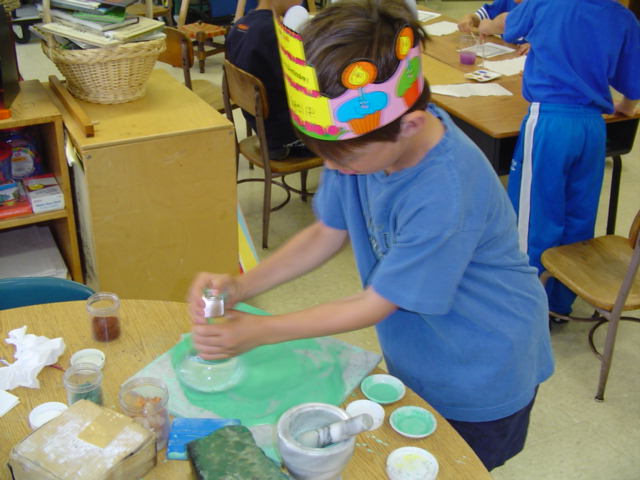
From the Earth Up Art from the Earth Up is an exciting and effective way
for students to learn. In this program, students create original artwork
while also creating their own art supplies from natural materials such
as stones and bugs and flowers. Recipes and techniques that have been
practiced by many cultures for hundreds, even thousands of years are
utilized. With a focus on the medieval and ancient European traditions
of manuscript illumination and panel painting, connections are made
to Eastern, Asian, African and Indigenous traditions, who often utilized
similar and related techniques in their own unique art forms. The process
of creating art from the "earth up"- finding the sources for inks and
paint, making the art supplies, using them in original work, and incorporating
our cultural traditions- sparks a creative and unique attitude towards
learning and begins a lifelong understanding that we are an integral
part of the human and natural world. This method gives students a sense
of the great historical context in which we live, and reminds them of
how culture, and especially art, connects us all. This well-rounded, interdisciplinary and integrated approach brings history and learning to life, and students remember, retain, and use what they have learned throughout their lifetime. As an artist and educator, I continue to learn with every school and every student, and my commitment and enthusiasm grow with each program. The love of learning is the best education. The Overview Session
|
|
The overview session, a lively lecture and discussion, is an introduction to the history and techniques of sources for artist materials used in paintings and the book arts throughout the world. Used in a program incorporating several different workshops, the overview session is designed to involve and interest the student through questions and discussion, as well as an extensive display of materials, in the process they are about to embark upon. The process is explained in a step-by-step fashion. In all possible cases actual materials are passed around to students, with an explanation of how and why they were made, their uses and their history, and students are engaged in trying to figure out what the materials are. Odd and unusual facts and objects are used to create interest and excitement. This includes everything from animal skin parchment, including samples of sheep calf and goat skins; turkey wings showing feathers for making quill pens; oak galls or lamp soot for creating inks; real 22k gold leaf; various stones, insects and flowers used in making paint; to the materials of bookbinding. The age and level of the student determines the depth of information. This overview generates excitement about the materials and the workshops to come.
|
|
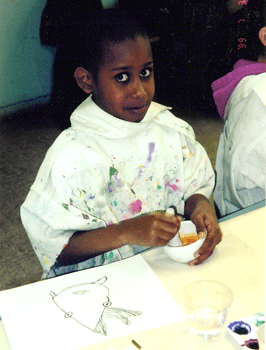
The depth and level of all workshops are custom-designed to be age appropriate. Workshops can be specifically catered to the needs of a particular school, class, teacher or focus of study. This focus can be historical, scientific, artistic or an integration of all, while always remaining interdisciplinary. This program offers multiple opportunities for the teachers to involve the students both before and after the program. Depending on the focus of the program, students create anything from a single artwork, a group collaborative work, to an entire handmade book. Students are encouraged or required to complete a drawing, compose a short poem or story to paint or write in their work; the works can be finished at home for extra credit or for a student exhibition in their class or even in the larger school. Often teachers will bring elements of the different subjects into class for study before the program. Working closely with each individual school or educator, a program is developed that best forwards your vision. All materials used are non-toxic with normal use. Materials use is closely monitored for safety. Students come away from every workshop with a piece of artwork made with materials they have created, ranging from a single page to a complete bound book by the end of the program.
|
|
Traditionally, ink was commonly derived from two sources: carbon or lamp black or oak galls. Carbon ink, derived from lamp soot, is still in wide use today. Oak galls are small wasps nests, formed by the laying of eggs on the branches of an oak tree. The galls are very high in tannin and gallic acid, forming the basis for a wonderful, permanent non-toxic black ink. Oak galls are found wherever there are oak trees! In this workshop students will discover what these materials are, why they were used and where they come from by actually making the inks themselves. The recipe is easy for any age group, and involves a chemical reaction clearly illustrating the transformation of a ground oak gall into black ink. If possible we will identify and/or collect oak galls from local trees. Ink in the workshop is made from soot and/or oak galls. Students will then test and use this ink in their own works.
|
|
Using real 22k gold leaf, students will learn and practice the traditional process of gilding. Gold is a natural metal found in the earth and containing unique physical properties that create the beautiful effects we are so familiar with. As a metal that does not oxidize, gold has been used to represent the eternal. The use of gold as a decorative and sacred element can be traced back to the Egyptians, and was used extensively in the sacred arts of cultures all over the world. Gold offers a valuable way for students to explore the ways we extract valuable natural resources from the planet, thereby gaining an understanding of the inherent value of raw materials beyond their economic worth. On their own work, they will apply gold leaf with the traditional breathing technique used in the art of manuscript illumination. Also possible is learning to burnish and/or tool (create effects by pressing shapes into the soft metal) the gold. The use of real 22k gold leaf offers a deeper understanding of precious materials found in the earth, and gives the students a sense of integrity and pride in their project.
|
|
|
|
In workshops where students create handmade books, they will learn a basic traditional bookbinding technique. Sewing together their own handmade book gives them a sense of completion in a project that they have created from the very materials to the finished artwork and which they can then take home. Students are encouraged also to complete their books at home if they don't finish in the workshop, often to be brought in later for credit or an exhibition of all the projects done in the workshops. An understanding of how books are constructed is another window into how things in the world are made for our consumption.
|
|
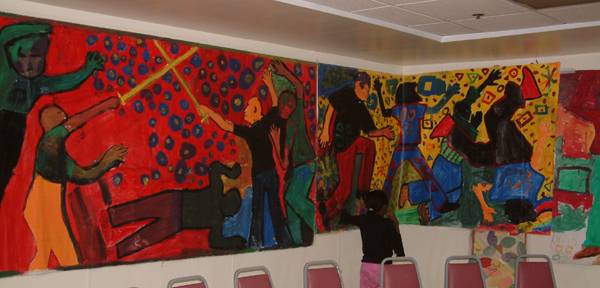
Image Making is an opportunity for students to discover their feelings and interpretations of their lives, our world, and the connections between the two, through an exploration of their own unique vision. Looking at the history of art from all cultures, and using the story of their own life, students can begin to bring to life an art form that expresses who they are, where they come from and where they would like to go. Art is a transformational path of discovery, when people are encouraged to explore their own vision with freedom and clarity; incredible works of art are created. Thinking outside the box, problem solving, creative application of knowledge, are all fostered in the nurturing of art. These skills are taken throughout a person's life, offering new possibilities and ways of thinking never before considered. In these complex and multifaceted worlds, being able to think creatively, with a confidence in your own vision, is one of the most powerful educational tools we can offer. A mind opened through art creates pride, joy and enthusiasm, for learning, for creating, for taking an active and self assured attitude for the entire journey of life.
|
|
Variations and possibilities for creative versions of this program are endless, from the length and breadth of the programs; to the focus on history, science, book arts or the Middle Ages; to the kinds of materials to be created. The vision is always expanding to incorporate the needs and ideas of those schools and educators with whom I work. Striving to work within the budget guidelines of every situation is always the goal. Schools can take on some of the copying of handouts and book pages, and teachers can be trained to assist with some of the processes.
The ideal of learning is to offer a new way for students to draw connections between everything in the world around them, from art supplies to material objects to food, to the earth from which everything comes, and to draw their own visions and conclusions from this knowledge. Many people have never seen a vegetable in its' garden, a person harvesting, a tree being turned into furniture. The human element in the labor of creating these products is emphasized. Without these connections, the future of our planet may be at risk. Connecting materials with the earth and the people who cultivate and consume them can begin a new way of looking at the world, one that considers how we extract resources and how we use the gifts of the planet. The goal of education is to inspire and enrich a student's life and hope for the future. Educators, schools, PTA, arts and community organizations are encouraged to be creative in designing a program for their institution. As an educator I am committed to this vision. The possibility of developing a dynamic program that is right for you and your students is a great privilege as well as a joy.
|
|
|
|
|